Hiya, everyone!
Now, over the last few weeks, I’ve been playing some of my favourite games in my spare time (what precious little of that I have left!). However, instead of just enjoying them, I’ve been thinking about why I enjoy them, and what I could learn or adapt from them for my own project. I’m gonna talk about a few of them here, and some of them may branch into spoiler territory so:
WARNING – SPOILER ALERT!!!
Anywho, now that’s been said, I’m gonna talk about a selction of games. They may not all be JRPG’s, however they have mechanics that have been used in JRPG’s so it counts.
First up is Fire Emblem Fates, which is quite interesting for it has three different story paths, based on a decision that you make in Chapter 5 (After doing this once, you can just start new games from after this point!). The three routes are basically parallel paths, but that’s wandering into story territory. What I’m here to talk about are the mechanics. Fire Emblem as a series uses a Tactical Battle System, which uses an overhead camera angle to show the battlefield. Each character moves on a grid, and can use actions like attacking, spellcasting, or using items. Characters can only move and act once per round (unless something happens, which I’ll get to later), and once all of your characters have acted, it changes to your opponents turn. It keeps going on like this until one side fulfills their objective (which is usually kill everything on the enemy side, but there are others).
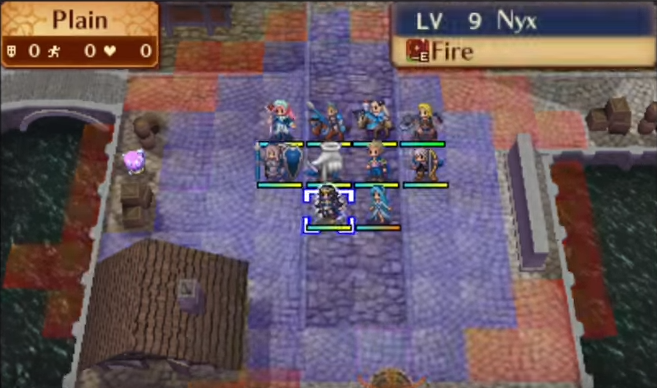
Now, there are two characters who can break the one move-and-action rule, Azura, and her son, Shigure. These two characters are bard-like, and have a magic song that only they can use. Using it on someone allows them one more move or action. As they have to use their action to sing, it’s basically just transferring their action to a teammate.
Another thing that the series has in later installments is the “My Castle” system, which provides the player with a customisable stronghold, which they can upgrade and control to suit their playstyle. It also gives them access to new items, equipment, skills, and spells, depending on what updrages they’ve done in the Castle.
Now, I happen to like Tactical Battle games, as I grew up playing Warhammer 40K with my dad, which is pretty similar to games like Fire Emblem. One of my minor gripes with a large amount of the Fire Emblem series is that you can’t fully exploit the terrain. I like being able to destroy the enemy’s cover, to navigate around it, or even use it against them with things like Fireball spells. It’s something that a lot of games forget about. But not my next choice.
XCOM 2: War of the Chosen is an absolute gem of a Tactical Battle RPG. I would have chosen the first game for this; XCOM: Enemy Unknown (and it’s expansion: Enemy Within), but I found the second game was a far better game in terms of mechanics. Actually, War of the Chosen is an expansion for the base XCOM 2 game, but it adds so much content, I could never play it without the expansion.

XCOM 2: War of the Chosen Cover Art 
XCOM 2 Cover Art
Althogh the XCOM series is based on the “Alien Invasion“, it still uses a lot of the same basic mechanics of the fantasy-orientated Fire Emblem series. Although, it does allow you to exploit terrain, which is something you can never really do in Fire Emblem. You have a selection of character classes, such as the mobile “Ranger”, hard-hitting “Grenadier”, long-range “Sharpshooter”, or tech-savvy “Specialist”. There’s even a “magic-user” type class in the “Psi-Operative”. As it only uses a small number of character types, you’d think your mechanically limited; your not. Each class has a “Talent-Tree” which you can use to specialise them in a number of interesting ways. The thing the expansion brings to your squad is the addition of allied resistance factions, which often combine aspects of existing classes into new and incredibly deadly squad members.
Now, XCOM 2 has an upgradable stronghold, in a similar manner to Fire Emblem, but with one difference; it’s an alien spaceship called “The Avenger”.
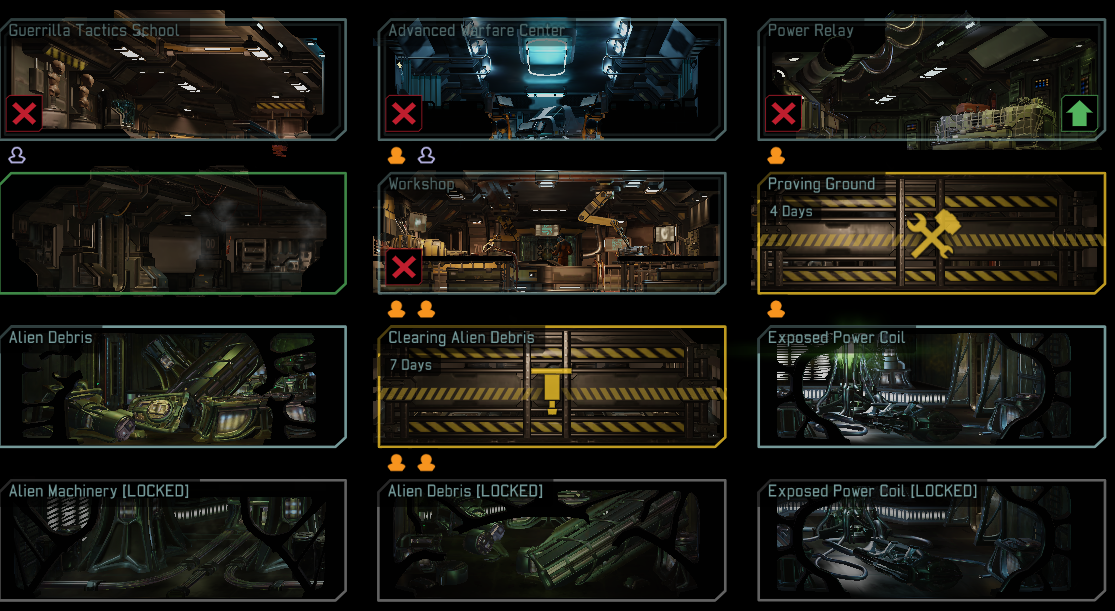
There are only a small handful of slots on the Avenger, so you have to choose what you want to build wisely. There is also a requirement for building rooms; power supply. If your power supply cannot accommodate the new room, you won’t be able to build it. Luckily, one of the options you can choose is the power relay, which gives you more power. If you build one on an exposed power coil, it gives more than usual. Now this is something I could use in my own project; not just an upgradable base, but a bit of resource management. Since I’m doing a more fantasy-orientated game, I’m probably going to use more mundane things like Gold or Materials.
Keeping with the topic of Tactical Battle games, I’m gonna move on to Suikoden II.
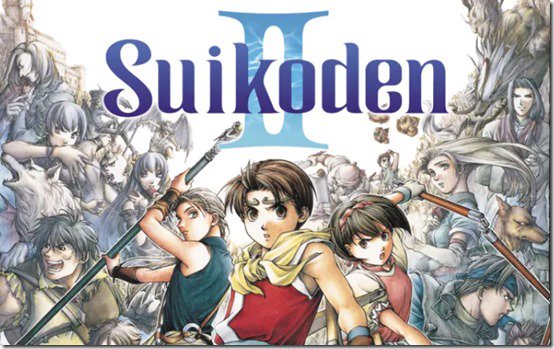
Now this game is very interesting; it actually has three battle modes! One is a SIX person skirmish mode, there’s a mass-battle tactical system, and a one-on-one duelling system. It also has 108 PLAYABLE CHARACTERS!!! Now I should explain, the Suikoden series is based off of “The Water Margin” which is an element of chinese mythology about the nine-dozen-heroes (9×12=108) who are fighting against oppression. There’s also a (quite badly dubbed) TV series based on the same stories, which is also called “The Water Margin“. Suikoden II also has a really interesting and unique Runic Magic system, that relies on “Rune Affinity” (a system that’s quite complex for me to explain). I can go through some of the basics of the Rune Magic system though; each character has a number of “Rune Slots” in which they can have Runes embedded (usually, they have two, but some more magically-orientated characters have three). Each Rune gives access to a small number of spells that can only be used X number of times. Runes can be upgraded to provide more potent or varied spells, depending on the Rune in question. For me, I like this system, as it’s a little bit more refined than the Materia system from FF7. I could potentially combine this type of system with the learn-by-use system introduced in FF6, which is something I’ve actually been thinking about for a while.
In addition to these features, Suikoden II ALSO has an upgradable stronghold, which in keeping with it’s source material is often near a body of water. It seems to me that in Tactical Battle games, having a player controlled stronghold is almost standard practice. Anyway, onto another game!
Final Fantasy Tactics. I had to get back to the JRPG giant eventually, but the Tactics series is a spin-off that uses the Tactical Battle genre, but combines it with a lot of the old Final Fantasy mechanics, ike the job system. The difference is that the jobs aren’t straightjackets like they can be in some core series entries. Instead, they improve your characters abilities, give them access to skills, and are freely changeable. You can even carry skills over between jobs! One thing is does use is a job-unlock system, where you have to level certain jobs up to a certain level to unlock other jobs, such as raising the level of white mage so you can get summoner. I suppose it’s to stop players from accessing powerful or complex abilities too early into the game.
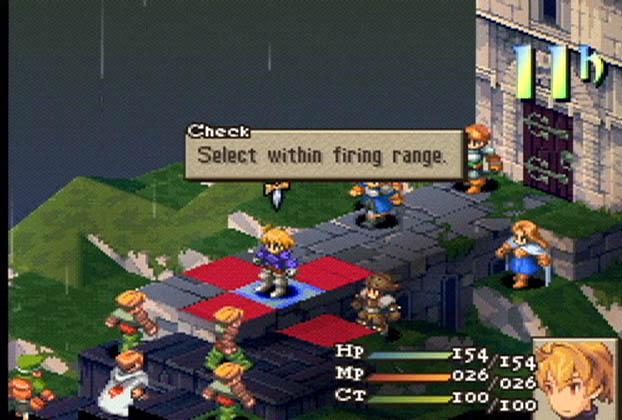
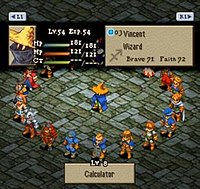
I could adapt this for myself, but I’m still debating whether I want any kind of “Job” system at all. I often find them incredibly restraining and difficult to balance correctly. They also don’t mesh well with any kind of learning system, due to their nature of dishing out skills at arbitrary levels. I could use them as a kind of growth model I suppose.
I’m hoping to pull a bit of a Suikoden with my own project, as I have a means of creating a traditional Active Time Battle (ATB) system that works alongside the Tactical Battle system (TBS). The only problem is gonna be the balancing (isn’t it always?). I want to have abiities that can be used in both systems without issue. One thing I’d like to experiment with is an ATB/TBS hybrid that uses the ATB’s pseudo-realtime system on the TBS battlefields. That should create a sense of urgency in battles, making it more imperative to think on your feet. I would make the ATB pause whilst your choosing actions though, otherwise the AI would destroy you in a matter of moments. I’d also rig the AI to only handle one unit at a time, so it’s a bit more fair to the player.
Anyway, I think that’s enough outta me for now, otherwise I’m gonna bore you to death. I’ll be back soon with something. I dunno what it’s gonna be yet, but I’ m hoping that it’ll be cool or interesting. Anyways, I’ll see you later!!!
Bibliography:
XCOM® 2 on Steam. (2016) [online] Store.steampowered.com. Available at: https://store.steampowered.com/app/268500/XCOM_2/ [Accessed 4 Apr. 2019].
Suikoden.fandom.com. (n.d.). Suikoden Wikia. [online] Available at: https://suikoden.fandom.com/wiki/Suikoden_Wiki [Accessed 4 Apr. 2019].
Fireemblem.fandom.com. (n.d.). Fire Emblem Wiki. [online] Available at: https://fireemblem.fandom.com/wiki/Fire_Emblem_Wiki [Accessed 4 Apr. 2019].
Finalfantasy.fandom.com. (n.d.). Final Fantasy Wiki. [online] Available at: https://finalfantasy.fandom.com/wiki/Final_Fantasy_Wiki [Accessed 4 Apr. 2019].

 SLGameDesign FMP