Hiya, me again! (I sure am writing a lot today!!!)
I’ve got a rough outline for my story (FINALLY!!!) for you:
Demon lord/god is attempting to enter the mortal world
Demon lord/god must sacrifice the “Holy Maiden” in order to manifest
The world is tearing itself apart through wars
The wars are being fought by a number of sovereign states
Each sovereign state is trying to better its position
One sovereign state worships Demon lord/god
They started the wars in an attempt to locate the “Holy Maiden”
Main party member happens to be the “Holy Maiden”
This drags the protagonists into the conflict
I know it’s in note form right now, but I’m not too sure on the way the story’s gonna flow yet.
Looking at my story notes, I noticed something; I made a game around 3 years ago that used similar characters and themes. I’m wondering if I should use it as part of this project, as it would give me something to instantly sink my teeth into. I wouldn’t want to use it in it’s entirety though; that seems a bit too easy. I could use it as flashback or prologue material though, as the ending did say that there was worse still to come. I also have a tech-demo type thing lurking around from last year, which uses concepts that releate to my story notes, so I may fold some of it in as well. I don’t know how, but it seems like these two old projects
If I did recycle parts of my other games, I’d probably want to rebuild it to fit my new project. The game mechanics I used were quite primitive, so they’d have to be redone. Also, I’m not using the RPG Maker MV RTP (Run Time Package) Stock Assets, so I’d have to completely re-map everything. Luckily, my Region-Mapping technique comes in handy for doing quick remapping. I’m also gonna have to redesign the character roster, as they were based off of some tutorial material that I have. This time, I want to try and use a different way of balancing the gameplay.
Broadly, what I want to recycle is some of my original characters, and some of the backstory that I used to make the lore. I’m still going to try and rebuild the rest of it to be a bit more detailed and complex (not too complex though!).
A few ideas I have for the gameplay are:
Six Party Slots
A class system (maybe)
A learn by use skill system (maybe)
Character Specific Skills/Epquipment (also maybe)
A lot of maybes, but I still havent fully explored this yet. I still havent settled on a character cast yet either! I’m hoping to have the character roster finalised soon, but until then, I’ll get on with looking at mechanics and story elements. I often get people complaining that I’m not focusing on the story, but here’s my view on the subject; Focus on Story, but Don’t forget Gameplay. A game isn’t like a film, where the audience is just a passive observer. A games audience are the players, who aren’t just passive observers; they’re active participants. They have to be engrossed in the story, yes. But they still have to have a gameplay experience that they can enjoy, otherwise no matter how good your story is, no-one will play it to find out. Also, I’ve mentioned this before, but one of my personal pet peeves in gaming is where the games story and lore DON’T match up properly with the story. It’s incredibly disjointing and prevents me from enjoying the game.
Anyway, that’s enough from me for now, so I’ll see you later!
I went through the project plan, and then made a to-do-list of what needs to be done. I use a system of doing this based on an episode of Star Trek: Deep Space Nine that I watched as a kid. Basically, it works like this:
Things that I MUST do
Things that I SHOULD do
Things that it’d be nice if I COULD do
So, using that tempate, I came up with:
MUST DO:
Story Framework
Audience Profile
Character Research
SHOULD DO:
Medieval History Research
Medieval Battles Research
Medieval Tech Research
COULD DO:
PEGI and Copyright Research
Music Research
I chose to prioritise the story, characters, and audience over the contextual stuff, as without them, what use would context be? I need to actually have something for the context to be used for, otherwise it’s not really going to do much. The could do category is for things that I did write into the plan, but that aren’t of crucial importance.
Using this I should be able to get everything back on track before long. I’m just hoping that it’s not gonna drive me mad doing it! Anyway, I’ll see you later!
I’ve decided to take some time to have a look at where I currently am with the project. Well, my honest answer is I think I may be slipping a bit behind. The deadline for this project is at the end of May, and I don’t think I have enough material. I haven’t even told you what my story concept is! On the other hand, I’ve decided on what assets I’m gonna use, so at least that’s something.
A lot is riding on this project, as it needs to be at a certain stage for me to get into University next year. I suppose it’s fair to say that it’s terrifying me right now, especially as the deadline gets closer.
What I’m thinking of doing is starting to produce some parts of my game whilst I’m still finalising the details. That way, I can have a bit of wiggle room when it comes to how it plays, and how the story will flow. I’m still gonna post a short story outline for you, but I don’t really want to make it airtight just yet, as I haven’t even begun really thinking about the game mechanics. I don’t want them to be disparate, as that’s one of my pet peeves in gaming (I think I’ve mentioned this before).
I did post a project plan at the start of the project with dates on what I’d hoped to have done by a certain point. Unfortunately, no battle plan survives contact with the enemy, and about half of the plan still hasn’t been acted upon. I’ve just had too much to do recently. What I’m hoping to do though is re-evaluate the plan and see what parts are most crucial, and what can realistically be put to one side for a bit. Once I’ve gotten to a more stable stage, then I’m going to properly start production, doing engine work and researching how to replicate and modify game mechanics from other games.
Hopefully thats give you a clearer idea of where I’m at, and I’m hoping to get back on track soon. So until then!
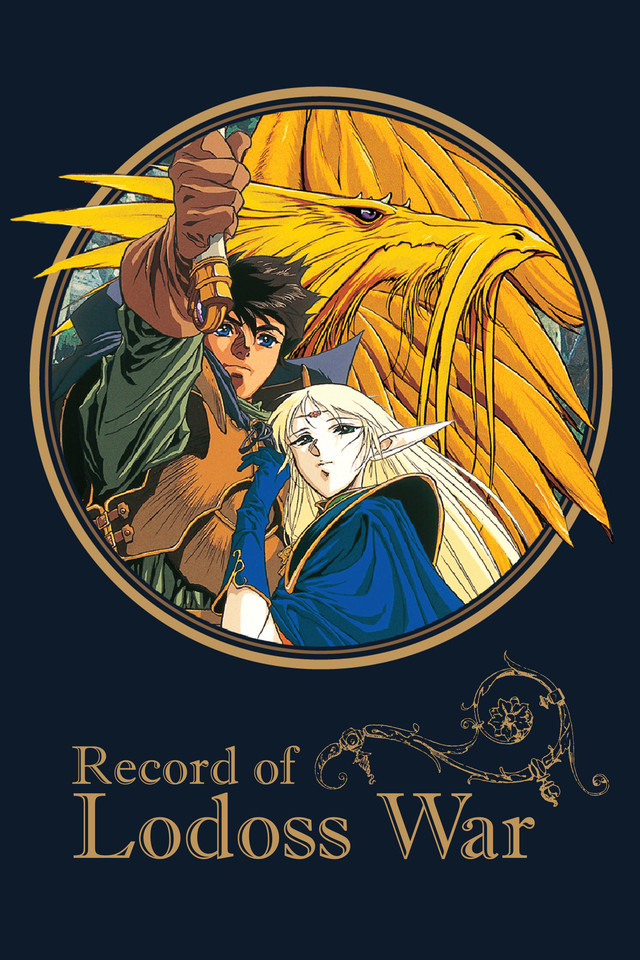
Today, I’m going to be looking at a Manga/Anime series for some story inspiration: Record of Lodoss War. However, before talking about the plot or anything just yet, I wanted to talk about the production itself. Originally published in the late 80’s by Kadokawa (the same people who publish RPG Maker MV!!!), and then made into an anime series in 1990, it’s actually based on a japanese-exclusive expansion setting for the original edition of Dungeons and Dragons. Because of this, it appears heavily westernised, featuring traditional western fantasy tropes.
Record of Lodoss War – Official Cover Art (Funimation)
Now on to the actual story itself. The basic premise of the series is to prevent the Marmo Emperor Beld from conquering Lodoss. Sound’s simple, right? Wrong. Behind the scenes, Karla the Grey Witch is manipulating events to try and “save” Lodoss in her own twisted way. The series opens with an adventuring party attempting to reach Wart the Sage, who may know how to stop Beld (He’s also familiar with Karla). The group is made up of Parn, the son of a disgraced knight, and his friend Etoh who is an initiate of Phalis, God of Light. They are initially joined by Slayn the Sorcerer, and his friend Ghim. Ghim is a dwarf who is on a personal quest of his own; to save the daughter of his friend Neese. Unknwn to the group at this time is that Karla is actually inhaiting the body of Leylia, Neese’s daughter. They are subsequently joined by Deedlit, an immortal High Elf, and Woodchuck, a notorious thief. Between them, they set off to save thier homeland.
As a story concept, it doesn’t sound too complex, right? Wrong again. An awful lot happens during the course of the series, including Beld allying himself with a group of Dark Elves (who are basically D&D Drow), and Ghim sacrificing himself to save Leylia from Karla. Not to mention Beld’s lackeys trying to sacrifice Deedlit to ressurect a dead goddess. Throw in magical artefacts like the Scepter of Domination, a McGuffin that requires the sacrifice of immortal blood to activate, and you have a fairly normal Dungeons & Dragons campaign setting.
Now there have been Japan-only SNES games on this series, but they’ve never had a official localisation, so I don’t really count them (as I can’t play them). But some of the story elements are things that I’ve actually done (being a D&D player myself) in game, so I may decide to use them for my own project.
I’ll post some links to where you can watch the series (please support the official release):
Over the last week, I’ve been playing the Golden Sun games on my GBA (I still have one!), and I found some story elements and mechanics that I particularly like, and that I’m considering for this project. Here’s a link to the FANDOM site for the series, which I’ve found quite helpful:
Before I get to that though, let me just go through a brief synopsis of the first two games (there is a third one for DS set 30 years after the first two, but I haven’t looked at it for this). The basic premise is along the lines of the “go-save-the-world” quest, but done from an interesting angle. I’ll try and avoid going into too much detail, as you may want to play the games yourself, so:
READER BEWARE: SPOLIER ALERT!!!
The first game starts as a group of Elemental Magic-users (or “Adepts” as referred to in-game) trying to stop the return of the “Alchemy”, an ancient and powerful supernatural force that has the potential to destroy the world. In order to release Alchemy upon the world, the four Elemental Lighthouses must be lit using the power of four magical jewels that contain the world’s entire Elemental Magic. Also, the player’s party has to follow a group of magic-users hell-bent on restoring Alchemy, and who are holding one of the characters primary love interest’s hostage, along with her brother and tutor. The game ends with two of the Lighthouses being lit; Mercury (the Element of Water and Ice), and Venus (the Element of Earth and Nature). The final boss is the two leaders of the antagonistic group, but the love interest character and the tutor are no-where to be found.
The second game filps things around, starting shortly before the end of the first game, answering some of the unanswered questions from the first installment. It opens shortly before the end of the first game, with the player controlling the aforementioned love interest; a Fire Adept in her own right, accompanied by the tutor. After a short escape from the geologically unstable Venus Lighthouse, they are joined by her brother; an Earth Adept, as well as another character that was also taken as a hostage during the first game, who is also an Adept who specialises in Wind Magic. They are later joined by a Water Adept who hails from the ancient kingdom of Lemuria, and who is older than all of the characters in both games PUT TOGETHER! They then continue the quest to ignite the remaining Lighthouses; Jupiter (the Element of Wind and Lightning), and Mars (the Element of Fire and Heat). During their quest they learn that if Alchemy isn’t restored, then the world will slowly waste away. Joing with the characters from the first game (who are at a default level unless the player uses a data transfer from the first game into the second), and as an eight-man group, they set out to save the world.
Post-game, it turns out that everyone was a pawn of the Mercury Adept Alex (the cousin of the first game’s Mercury Adept, Mia) and his grand plan to attain deification (godhood). He intended to ignite the Lighthouses in order to obtain the power of the titular “Golden Sun”, which is the combined power of all four elements. Luckily, during the opening events of the first installment, the monolithic “Wise One” (A giant rock with a single eye, that floats in the air) modified the Mars Star (the Jewel containing the world’s Fire Magic) to give some of it’s power to Isaac, the Venus Adept who is technically the primary protagonist. Alex is then cripled and left to die at the summit of Mt. Aleph, underneath the Golden Sun. Although his fate is left unclear at the end of the second game, Alex in fact does survive as he appears as a major villain/anti-hero in the third game.
SPOILERS END HERE
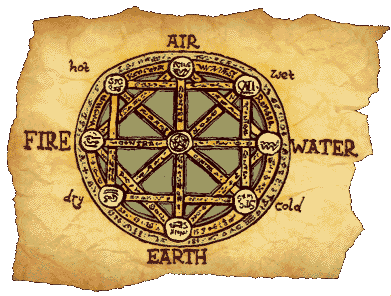
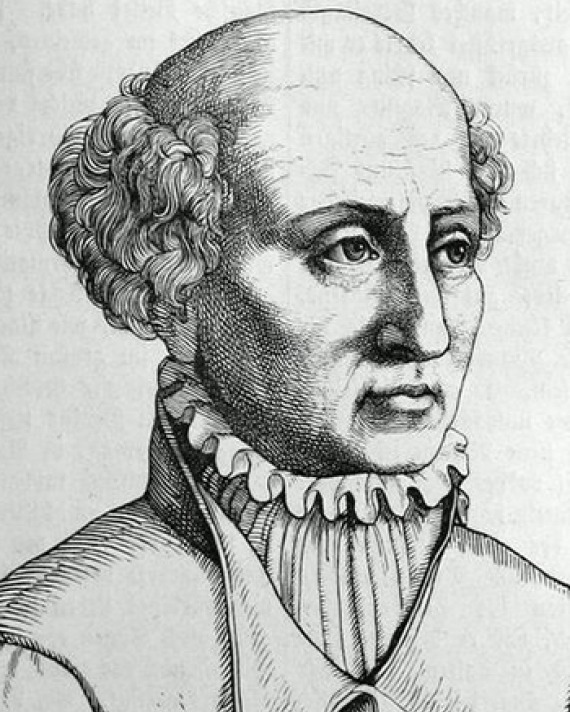
Mechanically, Golden Sun is a JRPG, plain and simple. Except it isn’t. It draws upon a large quantity of ancient cultures and myths to enrich itself. The core story and gameplay mechanics are based upon the classical greek elemental theory as described aby Aristotle, as well as the writings of the 16th Century Swiss Alchemist Paracelsus; whose actual name was Philippus Aureolus Theophrastus Bombastus von Hohenheim (The name “Von Hohenheim” was also used in the Fullmetal Alchemist Manga/Anime series as the inspiration for a powerful Alchemist character called Van Hohenheim, but I digress). Acording to the aforementioned elemental theory, there are four elemental forces: Fire, Water, Earth, and Air; which are in a state of perpetual balance (Fire opposes Water, and Earth opposes Air). Acoording to this model, the four elements are what make up the building blocks of reality, with everything containing more or less of each element according to it’s own compositon. The elements also exist in their purest form, as well as variant forms such as Ice (which is frozen water).
A Diagram representing Greek Elemental Theory (Aristotelian)
Paracelsus – Philippus Aureolus Theophrastus Bombastus von Hohenheim
Golden Sun – Series Logo
Golden Sun uses this model as the fundamental basis of it’s magic and character progression systems. Psynergy (the series name for magic) is based upon the elements, as each character innately specialises in one of the elements. There are two types of Psynergy; Utility Psynergy and Battle Psynergy. Battle Psynergies are used in a traditional way, being the spells that the characters can cast in battle to invoke various effects, such as damage, healing, or status effects. Some can also be used outside of battle, such as healing spells. Utility Psynergy on the other hand, is used outside battle to manipulate the environment; such uses include moving far off objects, freezing puddles, or even limited flight. Additionally, there are some battle Psynergies that double up as utilitiy Psynergies, such as Douse (conjouring water out of the air), Growth (causing vines to grow rapidly), Frost (which freezes puddles into usable pillars), and Whirlwind (a small cyclone that clears away debris), just to name a handful.
Golden Sun: The Lost Age – Prologue
Golden Sun – Battle
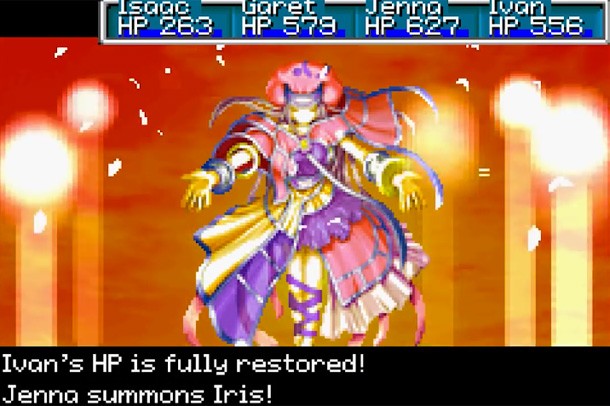
Golden Sun: The Lost Age – Summoning
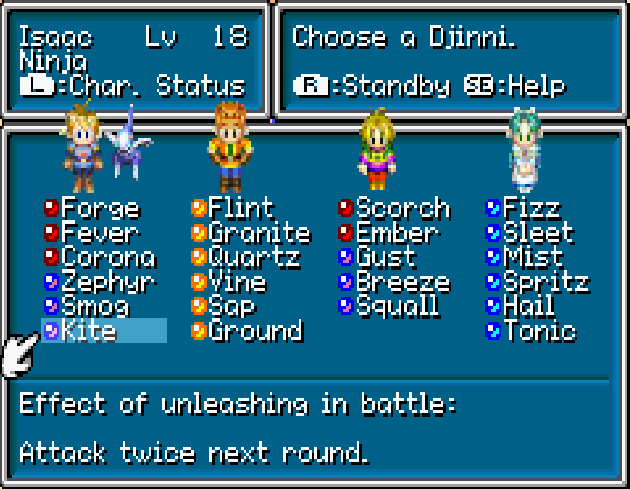
Golden Sun – Djinn Allocation Menu
Throughout the game, the player collects Djinn (which are based upon arabic and islamic mythology) which are aligned to a particular element. Assigning the Djinn to the party increases their stats, grants new spells, and changes their character class. Character classes are not used in a traditional sense, as they are changeable mid-battle (I’ll get to that in a minute), and only influence their abilities; they aren’t a cardboard cutout template like they are in other games. Djinn also have a two other abilities; first of which is they can be used directly in battle to provide a powerful magical effect, like attacking foes, applying or removing status effects, or changing or restoring stats or health. By doing so, they’re then useable for a second purpose; summoning mythological creatures that inflict massive damage on foes. However after they’ve been used in battle or for summoning, they stop influencing character spells and stats until theyve been re-set upon the character. Also, after using Djinn to summon, they go into a recovery period. this makes it impossible to use them to boost characters, use their abilities, or to summon for a short period of time afterwards.
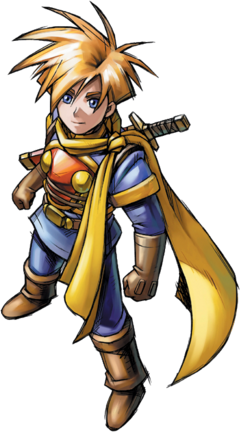
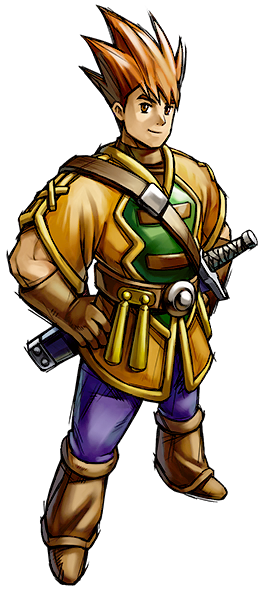
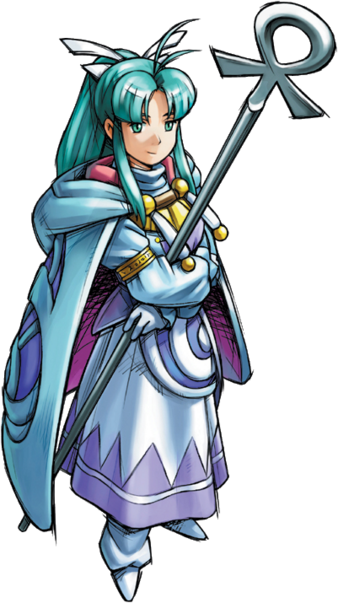
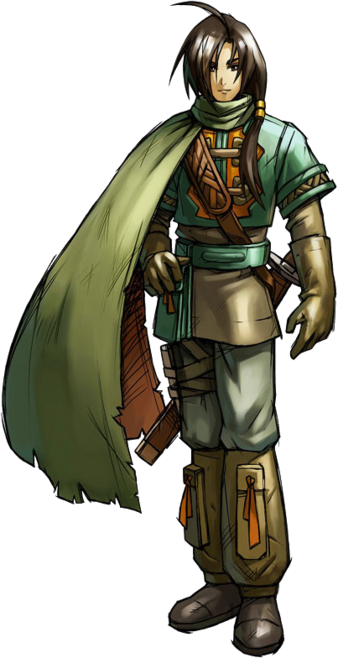
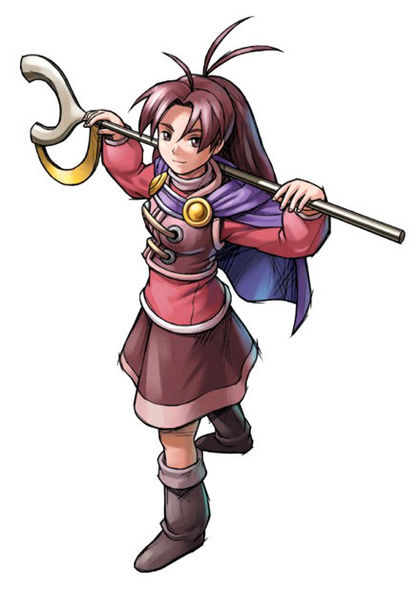
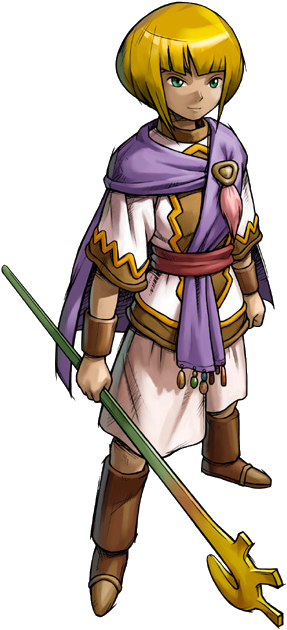
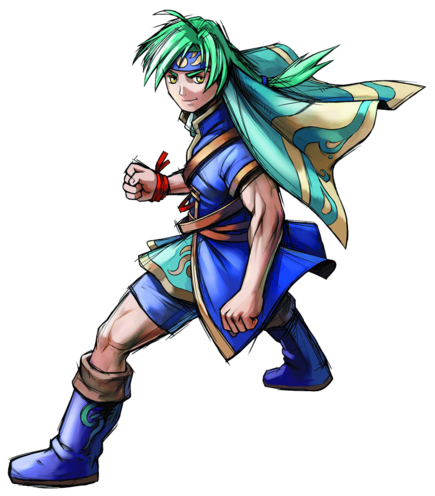
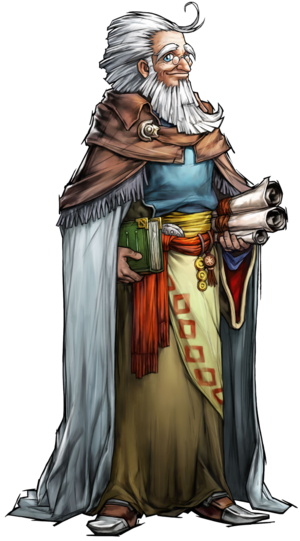
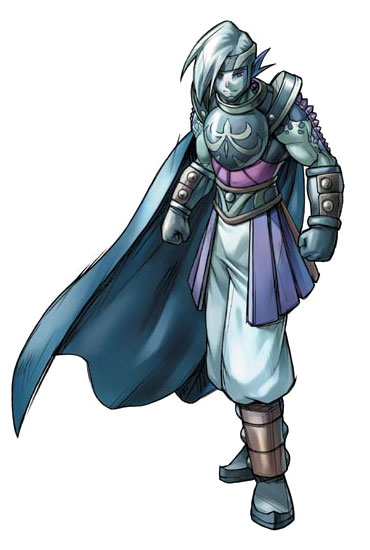
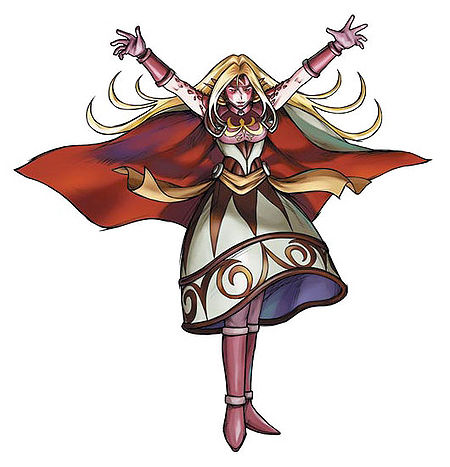
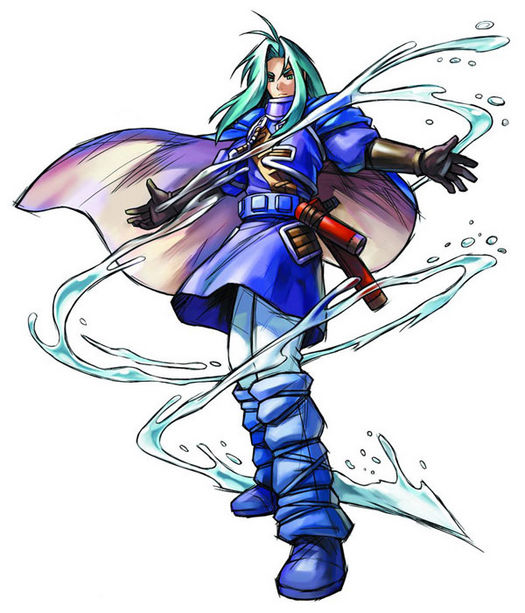
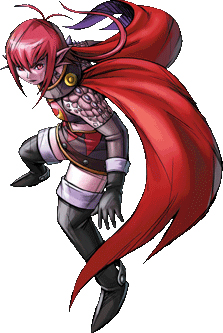
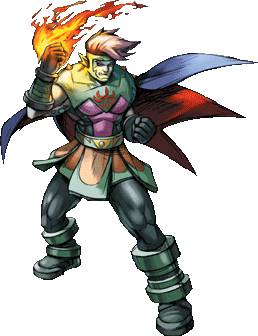
The characters are also incredibly well-written, with intricate story arcs and personalities. Here’s the official artwork of each of the characters for you to look at before I start talking about them in any detail:
Isaac (Golden Sun) – Venus Adept
Garet (Golden Sun) – Mars Adept
Ivan (Golden Sun) – Jupiter Adept
Mia (Golden Sun) – Mercury Adept (Alex’s Cousin)
Felix (Golden Sun: The Lost Age) – Venus Adept (Jenna’s Brother)
Jenna (Golden Sun: The Lost Age) – Mars Adept (Felix’s Sister)
Sheba (Golden Sun: The Lost Age) – Jupiter Adept
Piers (Golden Sun: The Lost Age) – Mercury Adept
Kraden (Golden Sun + Golden Sun: The Lost Age) – Alchemy Scholar
Saturos (Golden Sun) – Mars Adept (Primary Antagonist)
Alex (Golden Sun + Golden Sun: The Lost Age) – Mercury Adept (Mia’s Cousin + Main Instigator)
Karst (Golden Sun: The Lost Age) – Mars Adept (Primary Antagonist + Menardi’s Younger Sister)
Agatio (Golden Sun: The Lost Age) – Mars Adept (Primary Antagonist)
I’ve also created a Pinterest Mood Board based on the series, made of a mixture of fan art, official pieces, and other relevant works. Here’s the link for you now:
Golden Sun is property of Camelot Software Planning
I find the character designs particularly interseting, as they draw from a wide variety of cultural origins. For example, Issac is primarily designed on Medieval European, as opposed to Sheba, who looks more asian or mesoamerican. Also, there’s a mixture of styles in clothing shown across the cast, with Mia is wearing quite heavy robes in all of the artwork, as she comes from a frigid northern village, whereas Ivan is wearing light, slightly loose-fitting clothes due to his upbringing in a hotter environment. In some of the official art, it shows several of them actually casting Psynergy, but the way they each cast looks decidedly different; Issac’s is a great show of power, Ivan concentrates heavily, and Mia gracefully meditates. This helps show a bit of characterisation that wouldn’t otherwise be shown by pixel sprites. There is also a reason for the difference; not only do the characters wield different powers, they also learned how to use their powers differently. A perfect comparison is between Mia and Ivan: Mia is the heir to a long line of Mercury Adepts, with knowledge of what her own powers were and were they came from. Ivan on the other hand wasn’t raised anywhere near other Adepts, so his powers grew without him truly understanding them. He only found out about the true nature of his powers after meeting Isaac, and then reuiniting with his long lost sister, Hama.
I’ve probably gone on long enough at this point, so I’ll close for now. I’m hoping to go into some more detail about this series (as well as a few other game series), and what I intend to use as inspiration. So until then!
So, trying to get all of the research done before producing anything just wasn’t working for me. Instead, I’m now going to produce and research simultaneously. This should help get something made, whilst also telling you why I’m doing what I’m doing.
Today, I’ve been working on a bit of file management (amonst other things that I’ll get to later), as I needed to add a vast array of assets into my shiny new project file. Now RPG Maker MV comes with an RTP (Run Time Package) that contains a variety of stock assets. They’re nice, but a bit too pixel perfect for what I have in mind. I’m a massive retro gamer, so I thought I’d create my game to be a sort of “Love Letter” to the games I grew up with. With that in mind, I happen to have access to some paid assets (that are available through RPGMakerWeb, STEAM, Itch.io, and even the Unity Asset Store!), by an artist called Jason Perry. I’ve been subscribed to his patreon for around a year and a half to two years now, and have previously bought licences to use his assets in both non-commercial and commercial projects (provided I give the proper in-credits reference). Jason’s “Time Fantasy” set is what I’m going to be using, as it is heavily inspired by SNES and GameBoy Advance style JRPG’s (which is exactly what I’m being inspired by!), so they’re beyond perfect for me. I may have linked to Jason’s work before, but I’ll do so again for good measure:
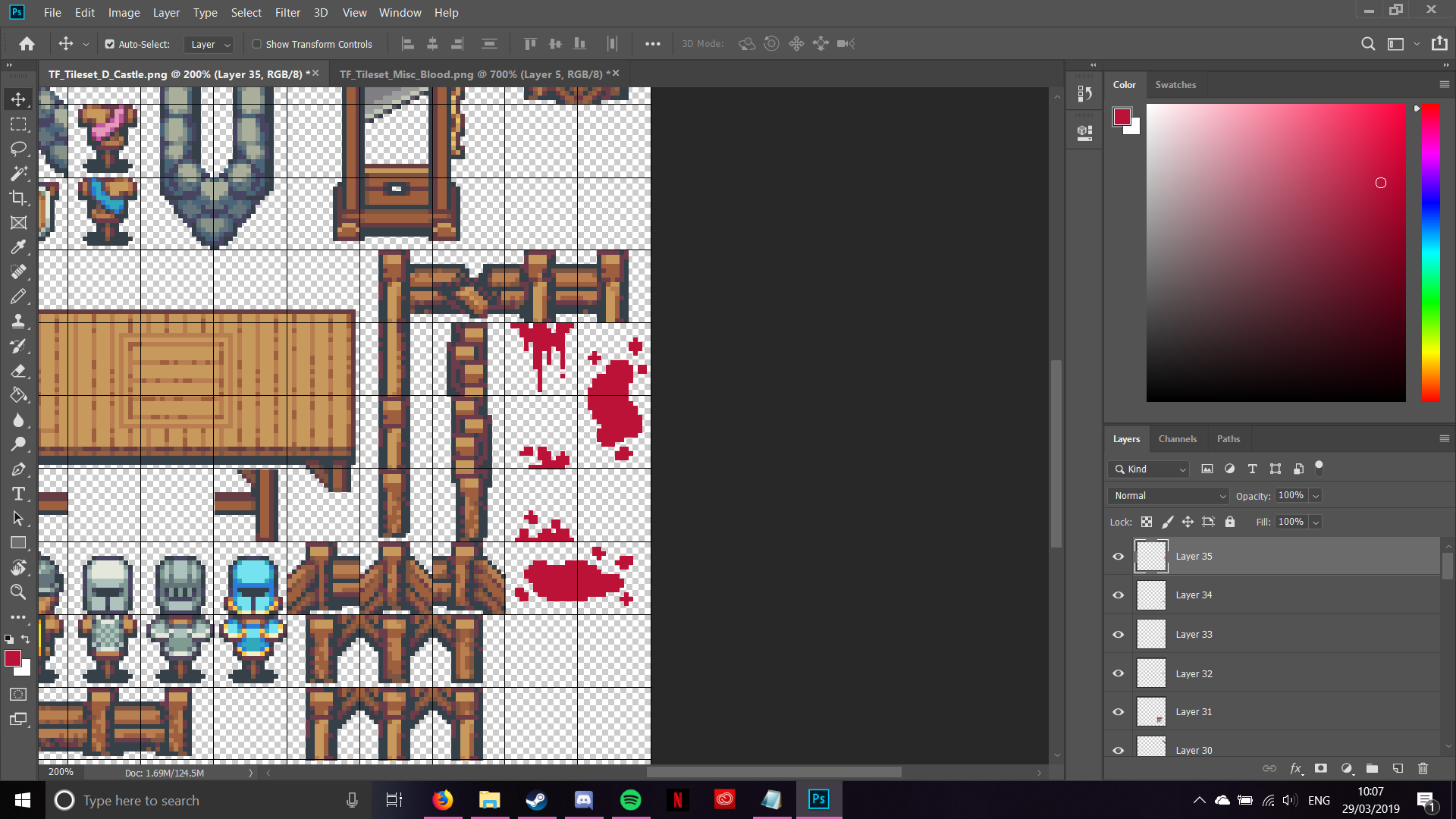
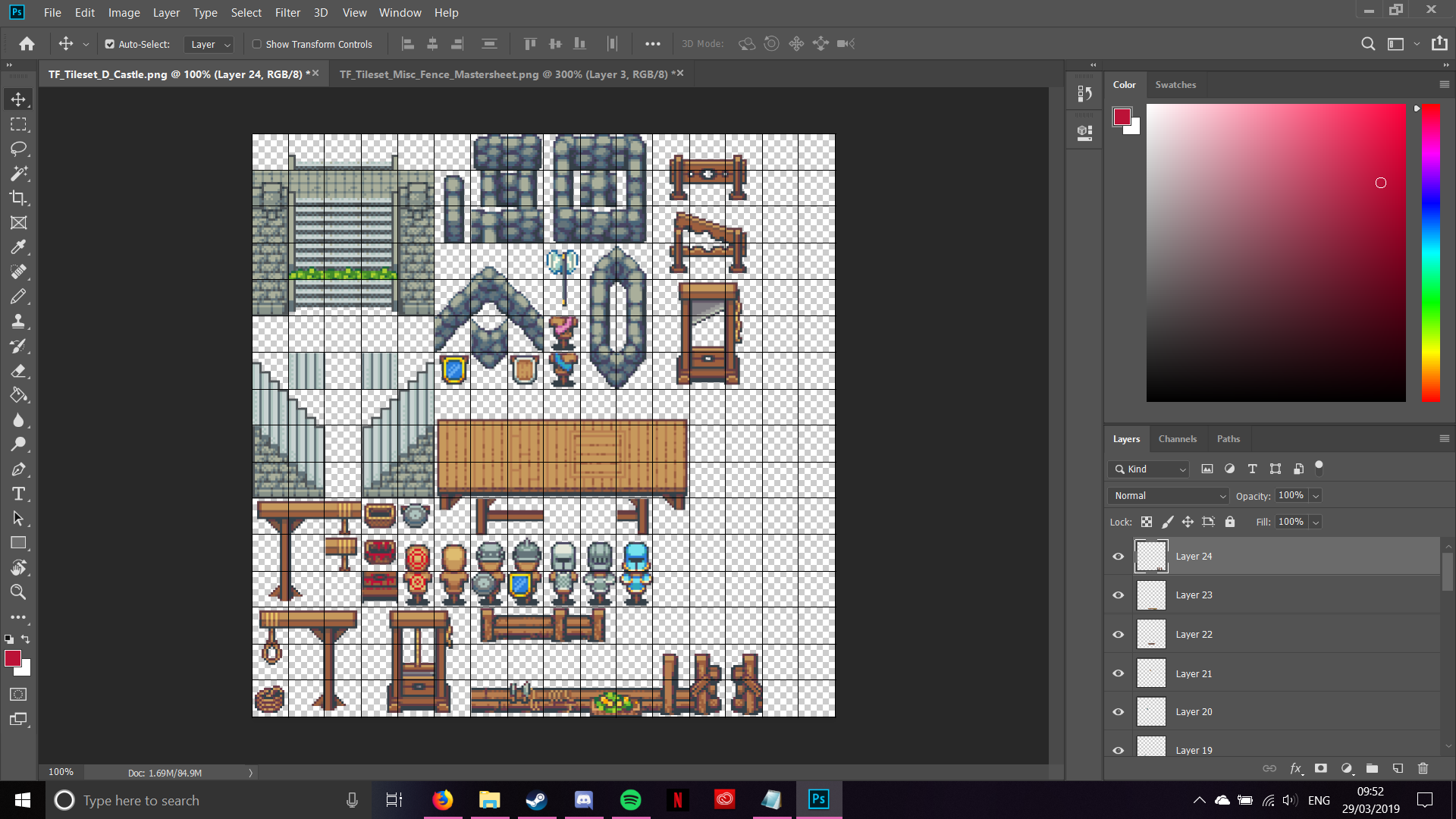
After digging all of the assets I have out of my backup drive (it’s over 4GB at this point!), I imported all of the visuals. I’ve done some Tileset Compositing as well, using the Patreon rewards I’ve been collecting to built a custom tileset. The tileset’s for a castle courtyard/grounds, as many castles weren’t just imposing fortresses, but were thriving hearts of the community. I took some screenshots of my Photoshop work for you:
Although you can see some bloodstain images on the left, I had to remove them, as I’d forgotten to put in the wells (seriously, how would people drink water without wells?). This was over 30 layers of work in the end, as each section was placed on a seperate layer for easy swapouts and editing (I felt like I was going a bit mad!). I did export it, and even imported it into the engine. It works, even though it’s a bit cramped. I’m going to spend some time at some point composting a load of the Patreon reward tiles into functional tilesets for use.
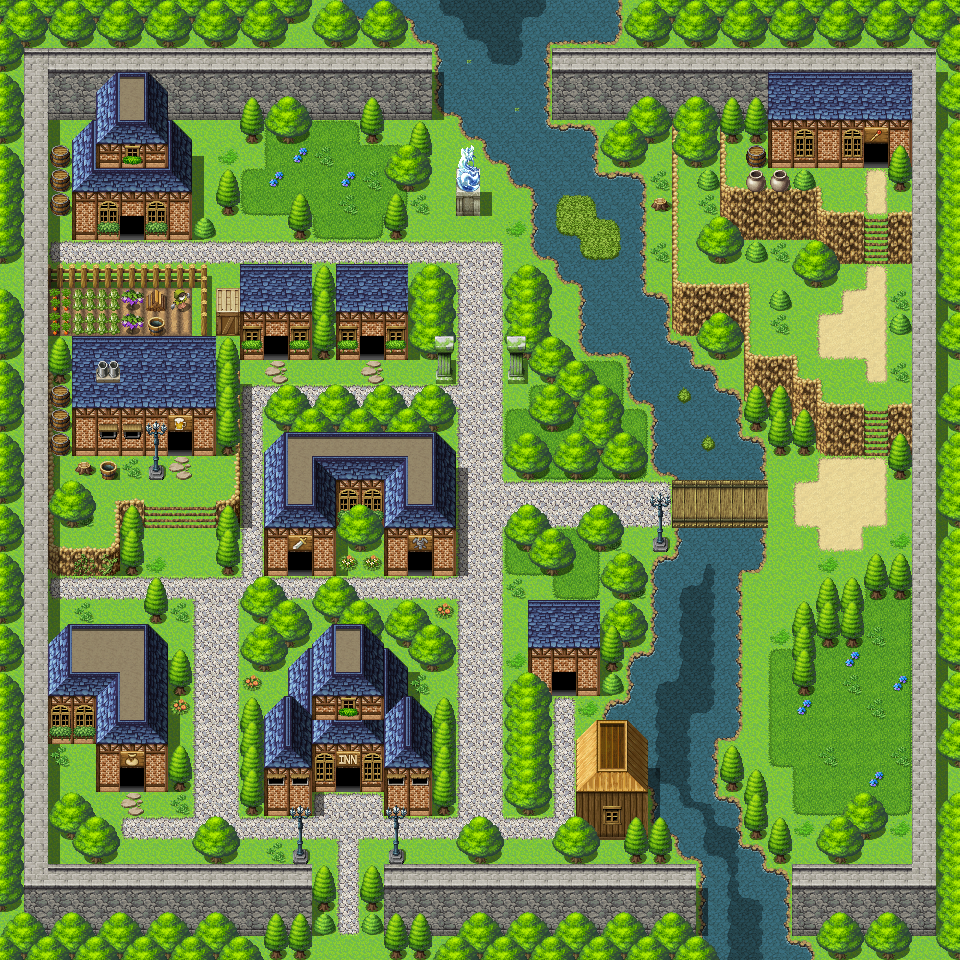
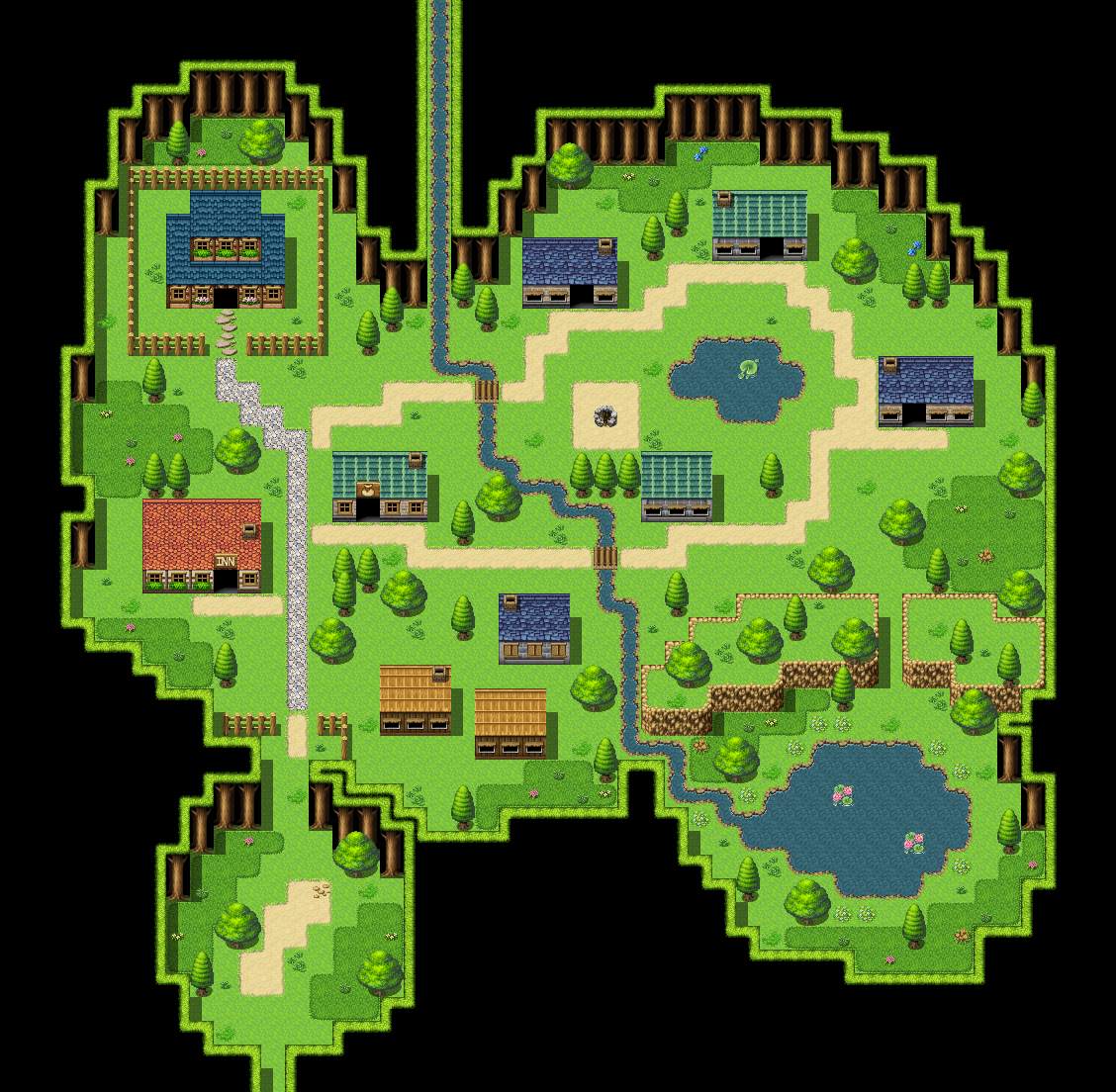
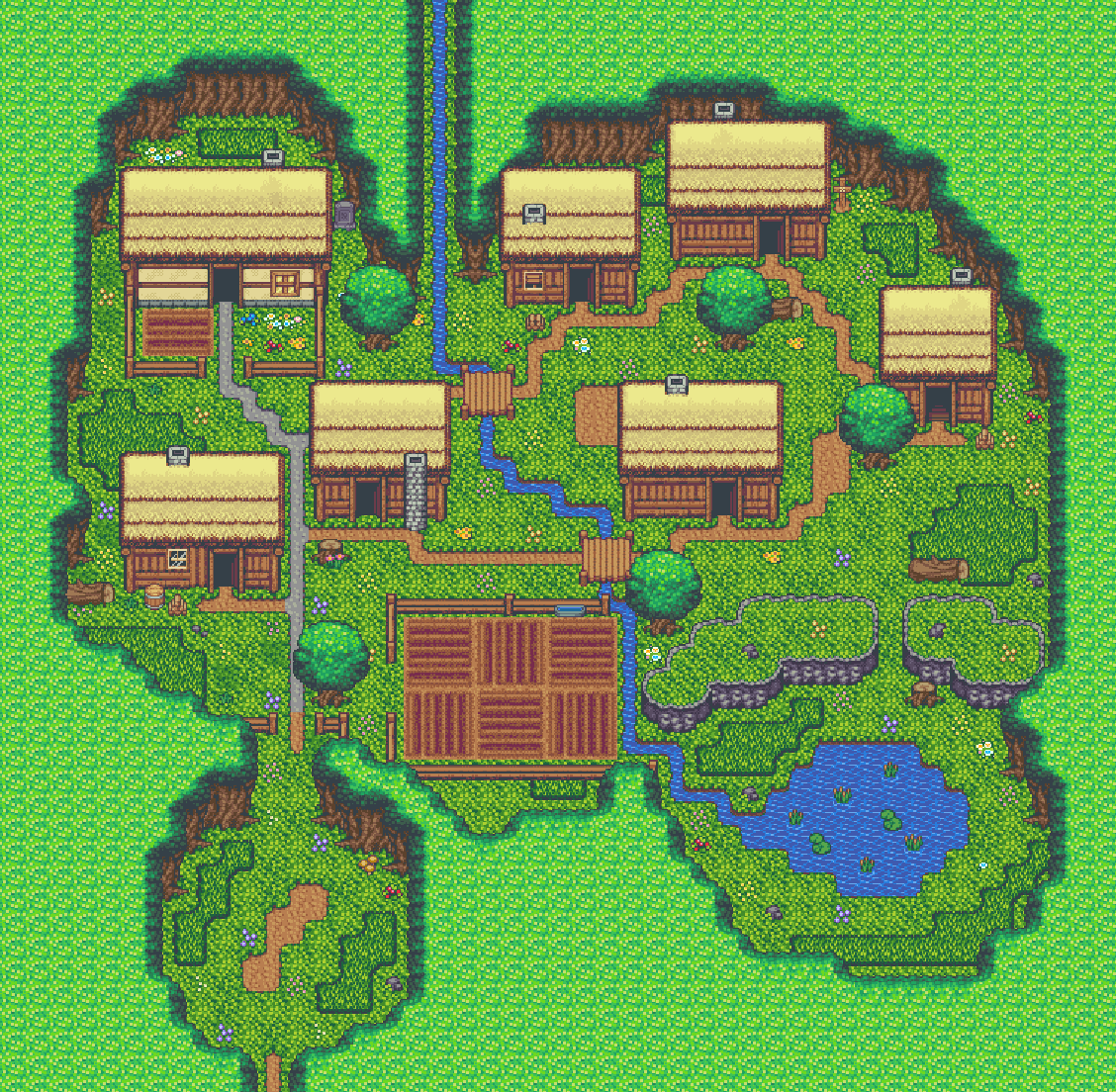
Speaking of using tilesets, I did some conceptual ideas on a woodland village that’s been rattling around in my head for about a week now. Now, as it’s been a while since I did any RPG Maker MV mapping, I decided to look at the pre-built sample maps for something to work from. I looked at the one that comes with MV, but I didn’t like it very much. Luckily, I also have a licence for it’s predecessor; RPG Maker VX Ace. I’d spent time over last summer converting the sample maps from VX Ace into MV, so I could have a browse at it’s samples library. I found something that suited my needs in the “Forest Town” sample.
RPG Maker MV – Sample Map “Forest Town”
RPG Maker VX Ace – Sample Map “Forest Town”
As I’m only testing tilesets at this point, I’m not too concerned about using samples (they’re there to be used, aren’t they?), and I had an idea for a forest village tileset that used multiple tileset components. Just to clarify that last point; RPG Maker MV uses tilesets composed of multiple pieces: A1, A2, A3, A4, A5, B, C, D, E. You don’t need every component slot filled, but each tile designation has a specific purpose. A1 deals with animated tiles such as water or lava; A2 handles ground tiles; A3 and A4 are walls and roofs, and A5 is what’s termed as “normal”. It handles things that aren’t autotiles, but that can seamlessly mesh with them. (Autotiling creates a seamless patch of tiles, which is helpful for water and ground tiles). B to E are all details, that have no special effects and just look pretty (although you can event them to do stuff). Now, as you can see from the pictures, the VX Ace one is surrounded by actual woodland, whereas the MV one is surrounded by walls. Personally, the VX Ace sample looks nicer to me (write your opinion down in the comments!).
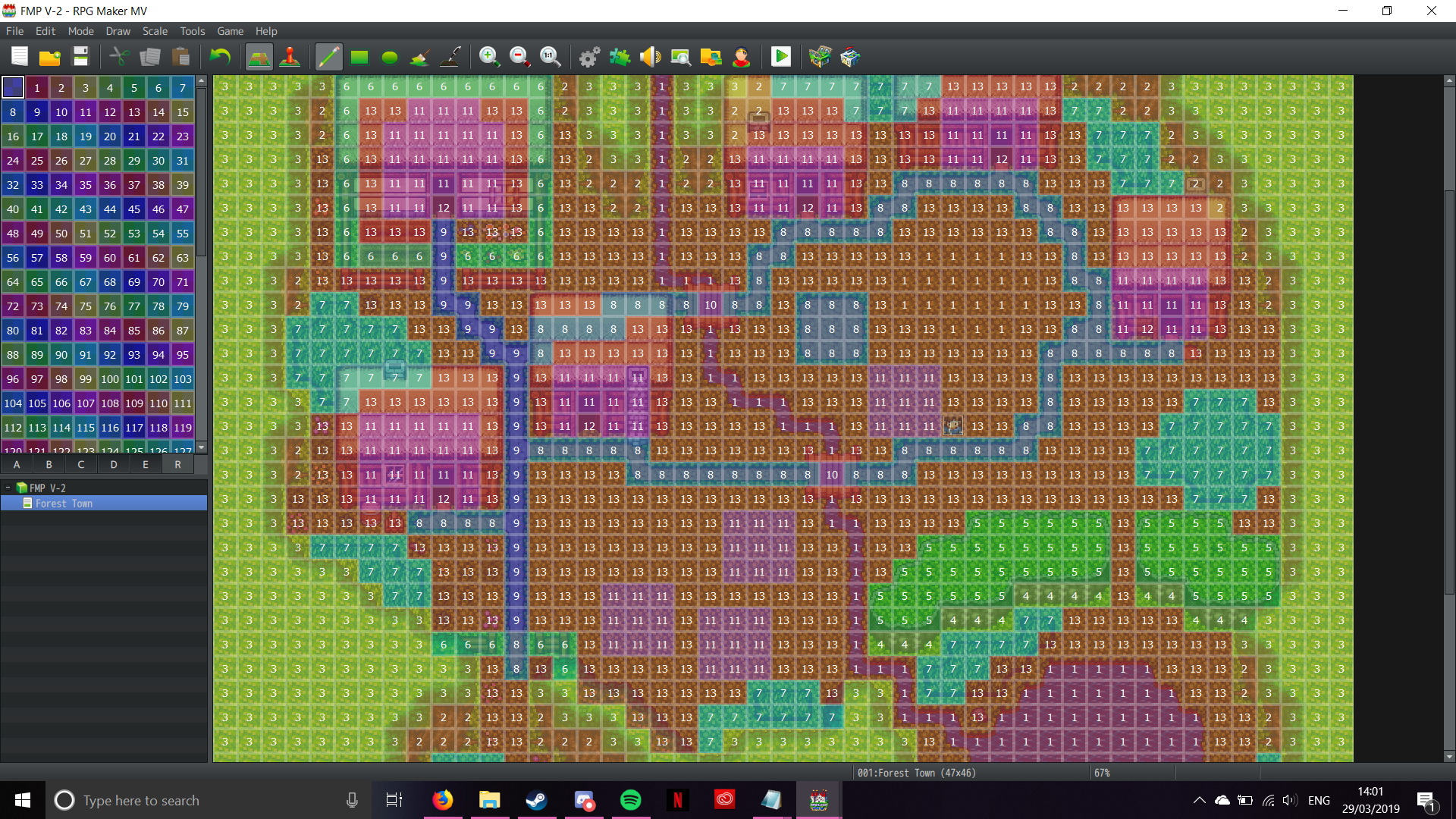
I started by using MV’s “Regions” system to create a rough guide to the map layout. Regions have many uses for programming and gameplay, but for now I’m gonna use it as a kind of painting by numbers guide to mapping. It also allows me to play around with layout without committing to any particular tileset or art style.
Region Mapping – My technique for quickly dealing with map layout
The image above shows the region map when I was about half-way through remapping. Each particular Region has a numerical designation, which I then use to say what it represents (kinda like Algebra). Here’s my list of Regions:
Region 1 = Water, Region 2 = Forest (the actual treetrunks), Region 3 = Forest Canopy (the leaves), Region 4 = Cliffs, Region 5 = Clifftops, Region 6 = Fences, Region 7 = Long Grass, Region 8 = Dirt Path, Region 9 = Stone Path, Region 10 = Bridges, Region 11 = Buildings, Region 12 = Doors, Region 13 = Grass/Standard Area Terrain
I generally allocate Region ID’s to specfic map features based on a simple system; A1 type tiles like water always come first, followed by major terrian features (normally A5), and the end one is always the A2 tile that the area is predominantly going to be. The rest just get put togther in whatever order I decide (I know it’s a it messy, but I prefer it that way). Now I can’t stress this enough; THIS IS JUST A GUIDE. I don’t stick hard and fast to the Regions, I just use them as a rough indicator of where things should go.
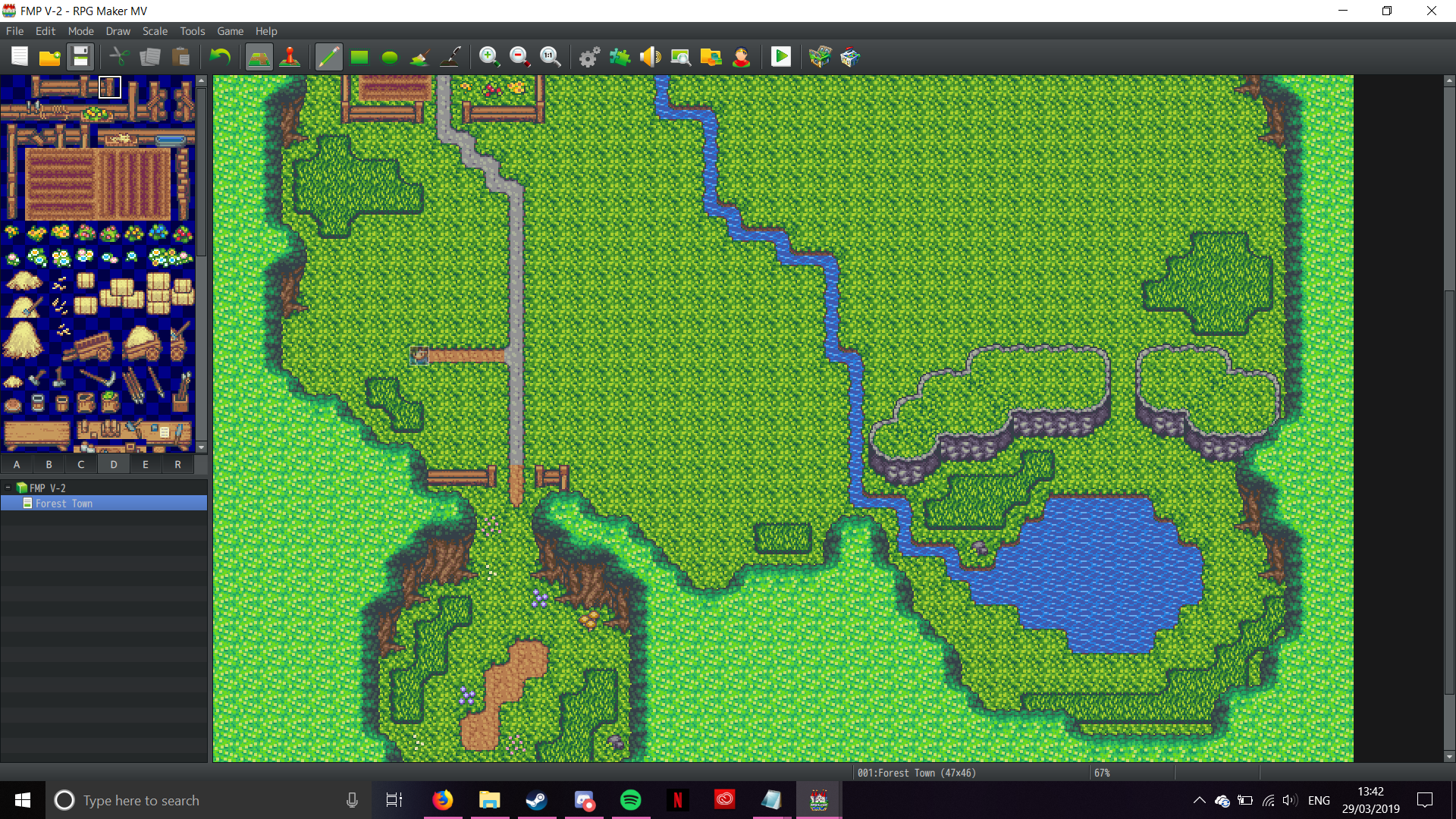
Forest Town re-make, 35% finished (Approx.)
Now, you may notice that on my WIP, it has two different colours along the path; this is deliberate. The path is part of the A2 tile, and therefore would leave an aggravating border between the two types of path. I found a way around this; Shift-Clicking. Using the Shift-Click when plcing autotiles makes the engine only generate the center of the autotile. I learned this trick from one of Echo’s Tips and Tricks videos, and it’s come in handy a lot. By shift-clicking the tiles where the two types of path touch, it then lets me do the sencod step of the process; by going over the grass around it with the grass auto tile, it’ll re-make the borderline between the two. Doing this, it creates the effect of having a seamless conncetion between two seperate terrain types. Pretty snazzy, huh?
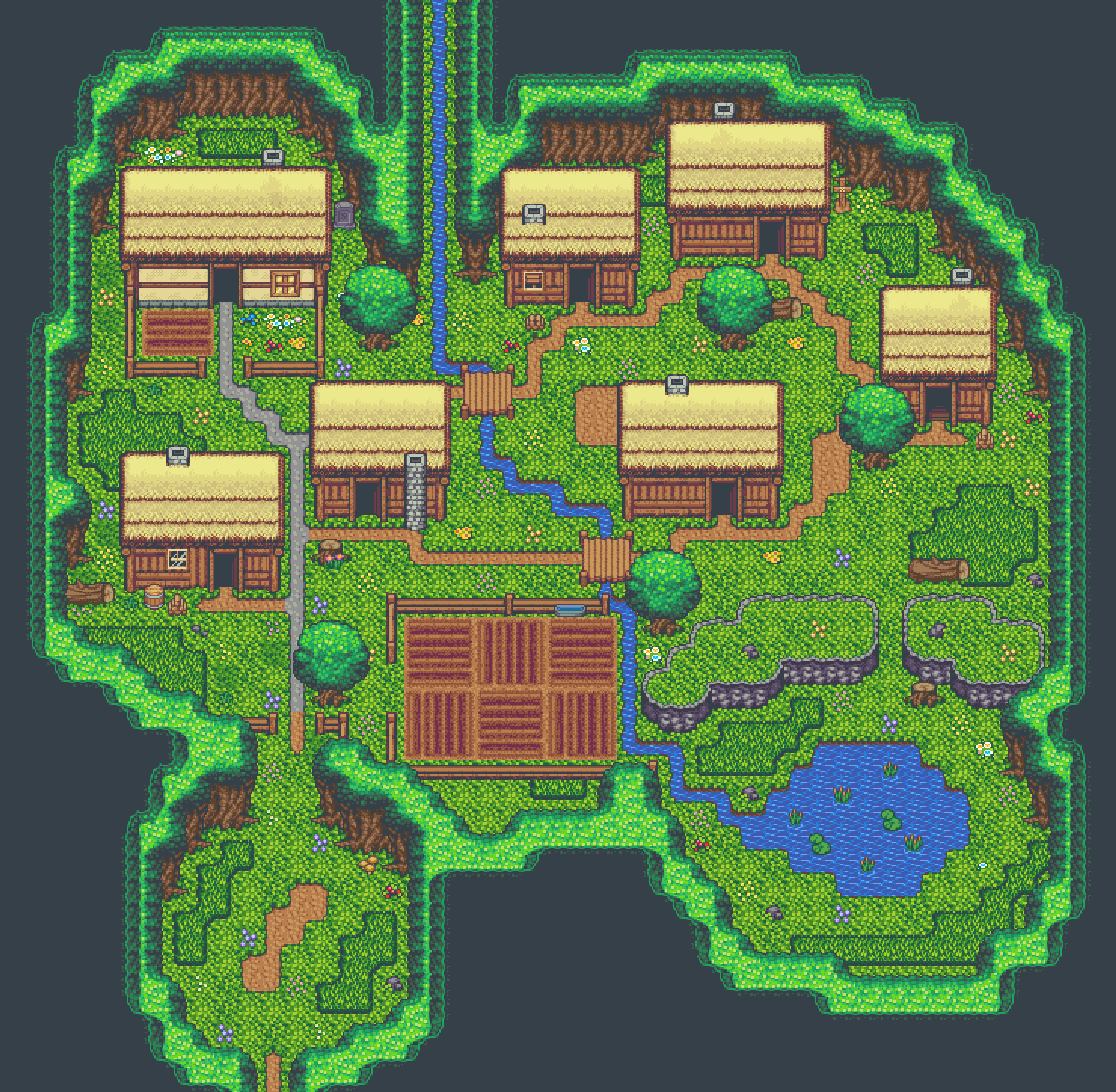
As I was getting towards the end of the re-mapping, I realised something. The map would have an enourmous amount of green around the outside, which would distract the eye, making it difficult to focus on the rest of the map. Luckily for me, I found a tile that creates a darker “second layer” of tree canopy density that makes it much more aesthetically pleasing. I took shots of the map before and after the adjustment; let me know what you think in the comments!:
Forest Town map – Before Adjustment
Forest Town map – After Adjustment
You see how the map is brought more into focus with the darker borders? I like it, as it makes looking at the map less of an eyesore. Whilst I would like to show you the full tileset here, I’m afraid I can’t, as it would count as Redistribution (which is prohibited by the licence agreement). It’s a legality that I can’t do anything about, but I guess that’s life.
I’m gonna close now with a little something; I should have an outline of my narrative for you within the next few days. So until then!
So, as stated in the project plan, I’m going to be looking at some fictional, historial, and mythological characters. Now as there are thousands of them, I’ve decided to narrow it down to three per category. For my historical and mythological characters, I’ve decided to look at; Jeanne d’Arc (better known as Joan of Arc), Chiron (classical greek mythology), and Eleanor of Aquitaine (who was at one point Queen of England). Although I stated that I’d be basing my project on medieval themes, I’ve decided to add some classical characters to the mix, as all the way through the medieval period, the official language of the catholic church was Latin (which has it’s origins in the ancient world).
For my fictional characters, I’m going to mix it up with one from a book, one from a TV series, and one from a game. I’ve decided on Talen from the Elenium and the Tamuli novels by David Eddings, as I’ve read the books and know a great deal about this character. For a TV character, I’ve gone with Tyrion Lannister. Now before anyone says anything about him also being from a book series, I’m going to focus on the TV series, as after a certain point, they deviate from the books anyway. Now for my game character, and don’t be surprised that you may not have heard of this one; Jenna, from the Golden Sun series. As I’ve been playing them recently, I’m not going to use anything after the point of which I’ve got to in the games, so not to spoil the game for myself.
It may take me some time to go through each character, so if I haven’t posted anything about them for a bit, don’t be alarmed; I’m probabaly still researching and doing the writeups.
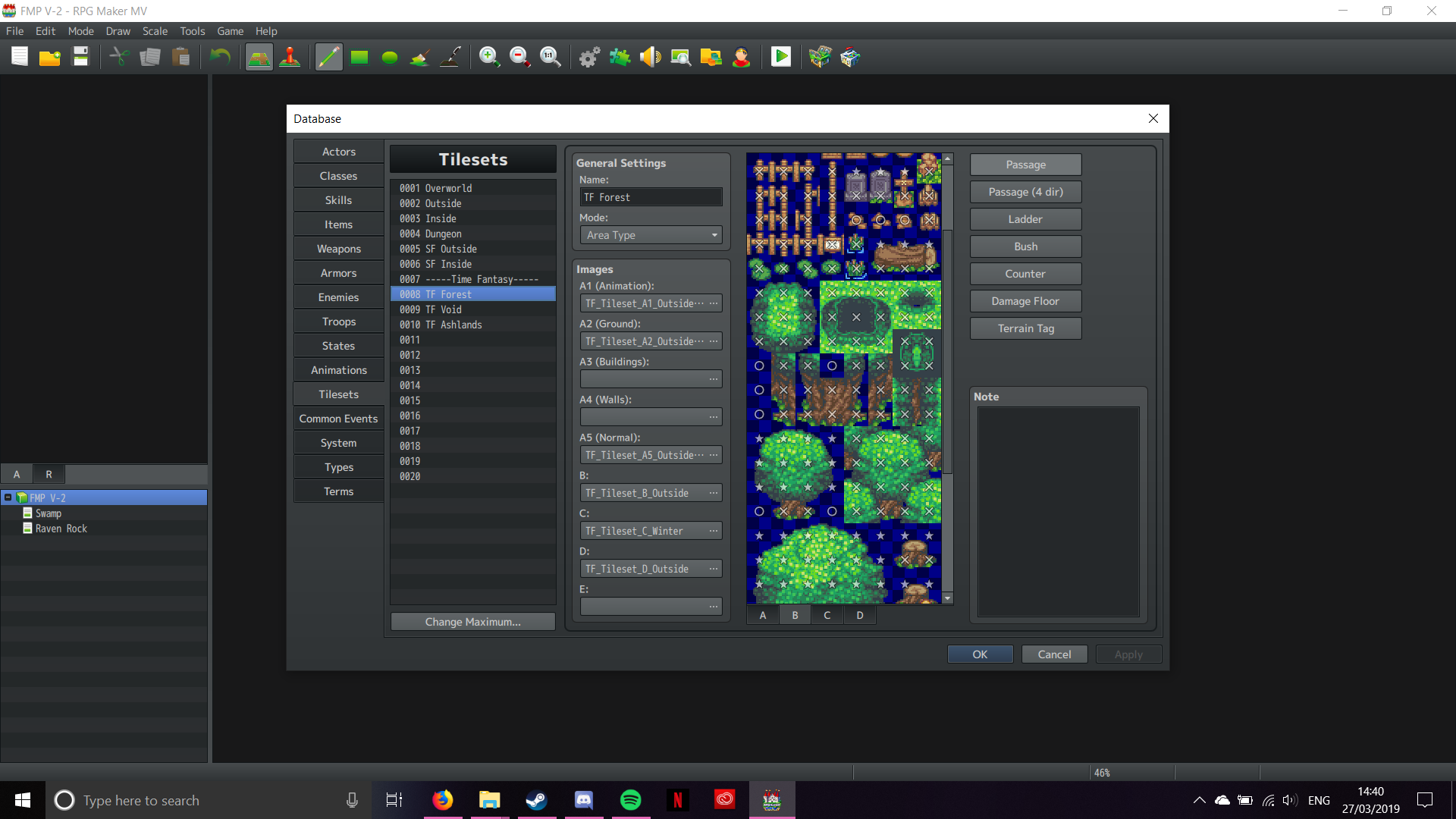
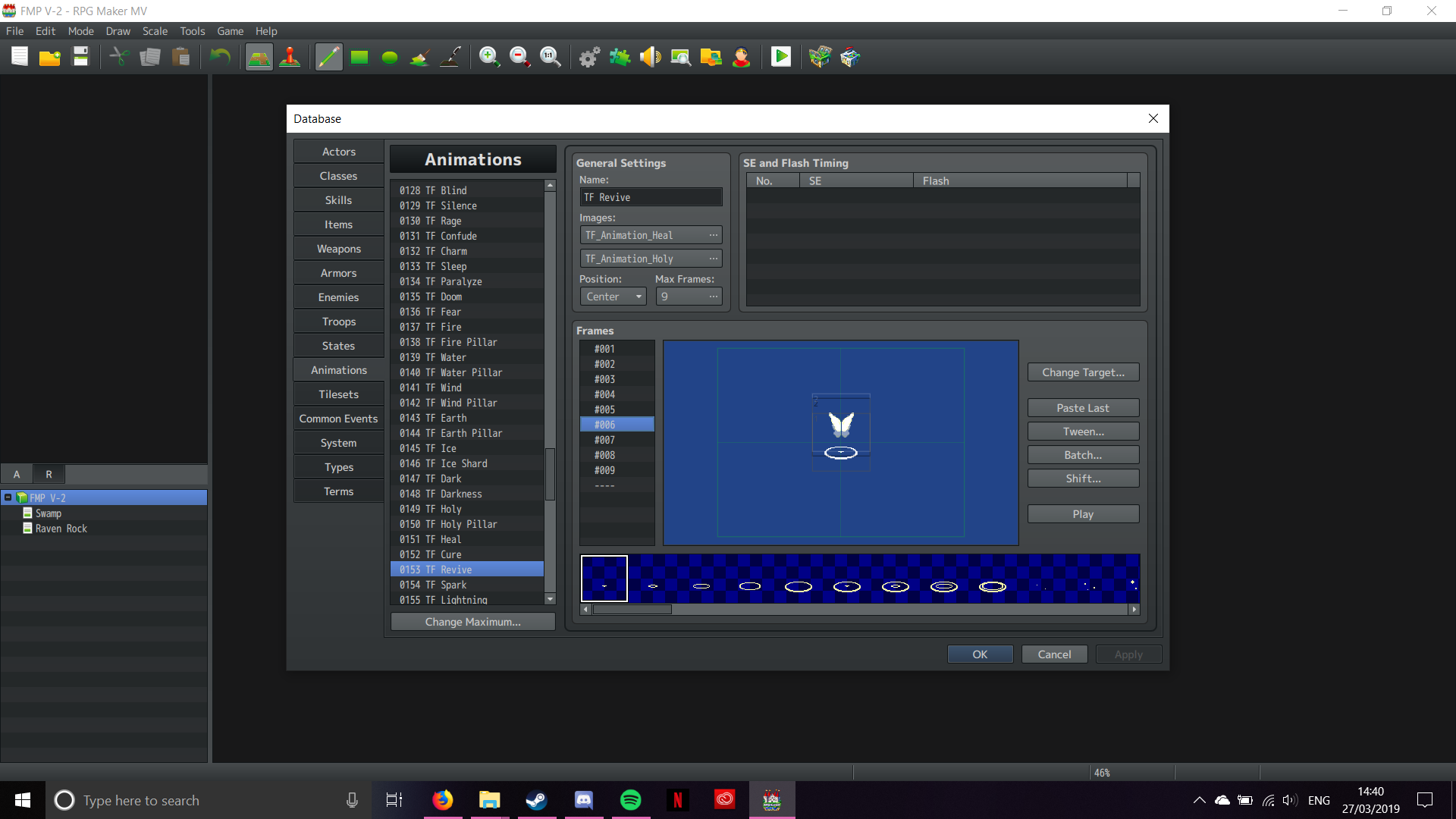
I’ve decided to do some some work in-engine on my project, as otherwise, I’m gonna have a whole heap of no fun later when I have to handle some of the tedium. By pre-organising my project, it’ll save me some time in a few weeks time. Also, it gives me a bit of engine practice. I’ve got some some snaps of my partially preorganised file for you:
Damage Types, Equipment Types, and Skill Types
Tileset Testing
Animations
I’ve sorted out (at least for now) the various equipment, skill, and elemental damage types, as well as many of the 16-bit animations. Getting the animations to work properly was the most tedious part, as many of them required to time them correctly. It was also the longest part so far, taking me around three hours to do half of them. In the end, I got a little bored, and tried my hand at configuring some tilesets. You may also notice that I’ve also created some sample maps with which to play around and test my tilesets with. Whether or not they make it into the finished product is a problem for later.
Now, I’ve been having some issues with coming up with a plot and characters. Well, I’ve got a very basic story concept now, but I need to decide on something before I continue; whether to do a traditional Final Fantasy style “Job System”, or do a system inspired by my Tabletop RPG hobby, and have characters get stronger and learn new abilities through using them. I’ll have to have a look at both, and see what I think would work better. But for now, this is what I have, so I’ll see you later!
As you can see, it lists all of the things I’ve done, by when I’ve done them. I’m doing it like this, as it makes the whole project easier to keep track of. I’ll also be including the links to the relevant posts, so I can easily find everything once I’ve done it.
The major hassle I’ve been having with the original plan is that it’s too fixed and narrow; it cramps my creative style. I need at least some level of flexibility when working, otherwise if I hit a major setback, it’ll stymie my production. The new plan is nice and sectioned, making it easier to record and sort through the production. Each section is clearly labelled, simplifying navigation. I’m also including a section as to whether or not the particular piece has actually been used in the production.
This has been a major issue over the last couple of weeks, but hopefully, this should get things back on track.
I’m having some serious issues coming up with plot ideas for this project. Actually, that’s not quite accurate; I have way too MANY ideas, and they’re all getting jumbled up in my head. I’ve tried writing ideas down, but it hasn’t helped. I try talking to people about my ideas, and they quite often tell me to shut up (normally quite unpleasantly), so I can’t do that right now.
Right now, I’d love to just make a load of mechanics, skills, items, and monsters. However, I don’t think my tutors would approve of me doing that right now, as I don’t have a concrete plot yet (quite the catch 22). Until I can at least do something, this project is stuck at an impasse. No way round it.
I’m going to have to deal with this issue, but I thought that I’d just let you know how I feel about everything. So until next time!




 SLGameDesign FMP