Hi everyone!
Something I’ve touched on before, but never really explored is the character development system. In lay mans terms, its the system that determines how characters grow and change mechanically. There are so many of these everywhere, so I’m only going to concentrate on a handful:
- Level System – General
- Esper System – Final Fantasy VI
- Materia System – Final Fantasy VII
- Sphere Grid System – Final Fantasy X
- Job System – Bravely Default
- Djinn System – Golden Sun
- Vocation System – Dragon Quest VI
- Skill Point System – Dragon Quest IX
Firstly, I’m going to talk about the oldest method out there: Levelling. It features in just about every game thats ever existed. The basics are that when a character gains a certain amount of “Experience Points” (EXP or XP for short), they gain a “Level” which is a rough indicator of the characters attributes and statistics. In addition, they sometimes gain abilities at certain “Levels“, such as new spells. Personally, I don’t particularly like this system, as I find it way too arbitrary. People don’t suddenly learn new skills, do they? That’s why I’m going to look at varying different systems, to see which one I prefer. I may even combine aspects into something original!
Next one on my list is the Esper System from Final Fantasy VI. Once you unlock the ability to use Espers, you can assign one to a character. Now the “Esper” does two things. Firstly, when a character “Levels“, they modify the character’s attribute increases, such as giving +1 attack power. The second thing they do is teach the character how to cast spells.
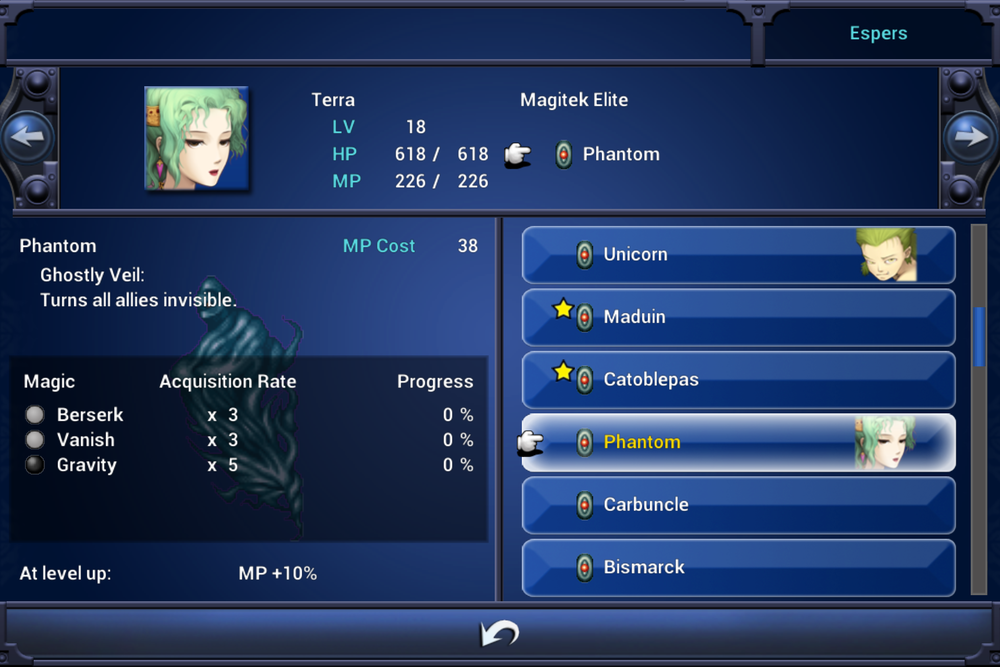
As can be seen from the above menu, the character gains spells from having the “Esper” equipped, with different “Espers” teaching different spells, and at different speeds. Once a character has 100 “Ability Points” (AP for short), they then learn that spell. They then keep that spell, even if the “Esper” that’s assigned to them is changed. The third thing an “Esper” grants the assigned character is the ability to summon the “Esper” itself, which has an effect on the battle, such as damaging enemies, healing allies, or another effect.
The next one I’m looking at is Final Fantasy VII’s “Materia System”. Similarly to the “Esper” system, you assign character’s “Materia”, which grants the character spells, skills, and stat increases. There are some major differences though. First of which is that the skills are not permanently learned; you have to keep the “Materia” equipped in order to use the ability. Secondly, the stat modifications are only whilst the “Materia” is equipped, so the character will lose the bonuses of having it equipped if removed. Interestingly, each “Materia” also imposes stat minuses as well, in order to balance the character out. These minuses are removed in the same way as the bonuses. AP makes a return, but instead of being assigned to the character, each “Materia” retains the AP thats gained. Once the “Materia” has reached a certain number of AP, it grows in power, and once mastered, spawns a brand new “Materia” with no AP, so you can spread abilities around your party.

One other difference this system has is that the “Materia” has to be assigned to the characters equipment, rather than the character themselves. Each item has a number of “Materia” slots, and some items have linked slots. Some types of “Materia” work better when linked to another type. Talking of types, there are FIVE types of “Materia“, each with different colours and properties:
- Magic Materia – Materia that grant spells. (Green)
- Summon Materia – Materia that allow characters to summon (Red)
- Command Materia – Materia that gives new skills, such as steal (Yellow)
- Support Materia – Materia that enhances other Materia that it’s linked with (Blue)
- Independent Materia – Materia that enhance stats, or have other effects (Purple)
The Materia system is interesting, as it allows the player to chop-and-change the character’s abilities on the fly, without having to commit to having fixed abilities.
Another Final Fantasy system is the “Sphere Grid” from Final Fantasy X. AP makes another return, but this time in a completely different way. When characters battle, if they participate, they gain AP at the end. In this system, AP works more like a traditional XP system, as when a character gains enough AP, they go up a “Sphere Level”. Characters can spend these Sphere Levels to move along the Sphere Grid. The Sphere Grid is made up of various nodes, along a path, somewhat reminiscent of circuitry. Each node requires a certain Sphere to buy. These Spheres are obtained through treasure chests, monsters, and certain other places. A character can buy an ability or stat increase in a node that they’re on, or adjacent to. Each character starts on a certain place on the grid, and they work their way around the grid, growing stronger as they go.

The main drawback of the system is the need to constantly rotate party members in battle in order to get them AP. This works fine for Boss fights, but for random battles, it’s extremely tedious, especially when you start being able to kill monsters in one hit. One interesting thing about the system comes from the character of Yuna, who has the ability to summon powerful creatures called Aeons. When Yuna unlocks stat nodes on the Sphere Grid, her summoned Aeons gain the bonus as well!
Bravely Default uses a more standard form of level based development, with a twist. Each character does have levels, which influence their stat growth, but these levels are separate from their character class, or “Job“. Each job has levels, which grow by the accumulation of “Job Points” (JP). Each Job can level up until level 14, whereupon it’s mastered. Mastered Jobs only really affect the Freelancer Job’s “Late Bloomer” ability, which provides a stat boost based on how many Jobs that character has mastered. Each Job Level grants access to new abilities and passive skills (called “Support Abilities“), as well as influencing the characters stat growth when they level.
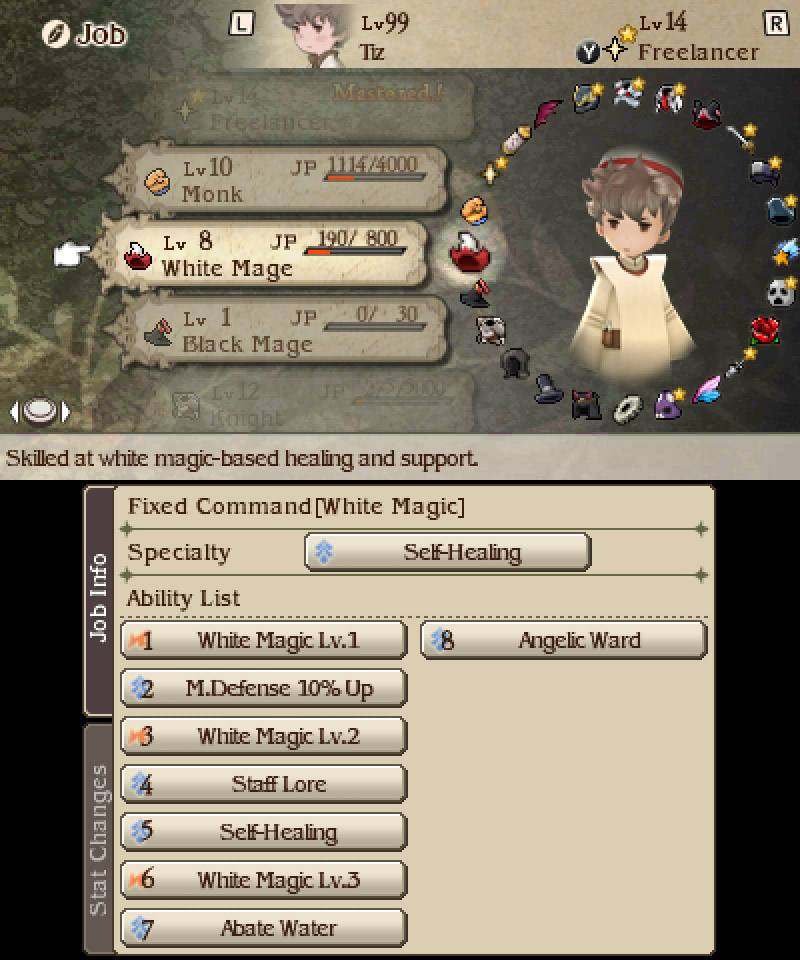
Abilities are learned automatically upon unlocking them, whereas spells must be bought from magic shops. Even if you buy a spell from a magic shop though, it still doesn’t automatically give the character the ability to use it. They have to have the relevant ability from a magic-using character class (such as “Black Magic” from the “Black Mage” Job). This system first originated in Final Fantasy III, further refined in Final Fantasy V, and then perfected in Bravely Default.
Golden Sun has an interesting level-based mechanic called Djinn. The Djinn are elemental creatures that can be assigned to the character (similarly to the Esper system), granting new spells and stats. Only difference is that, whilst each character levels up in the traditional manner, the spells they know are determined by certain quest-gained items, or through having assigned Djinn.

Golden Sun – Djinn Menu (Part 1) (GBA) 
Golden Sun – Djinn Menu (Part 2) (GBA)
As you can see, the Djinn menu is broken up into two halves, the first one showing which Djinn are assigned to which character. The Djinn’s names appear in different colours depending on their status; Set, Standby, or Recovery. A set Djinn gives access to spells and stat increases. A standby Djinn doesn’t provide spells or stats, but can be used to call upon powerful summons such as Thor. A Djinn in recovery has just been used to summon, or has been subject to the Djinn Storm spell. They cannot be set to characters or used to summon, until they have recovered, at which point they are automatically returned to being set. The second screen shows what changes occur when the Djinn is being set or placed on standby, including stat changes and what spells the character will be able to use. All the character class in Golden Sun does is tell the player at a glance what kind of abilities the characters now have, based upon the assigned Djinn.
For the final one I’m looking at, I decided to go with the Dragon Quest series. Now these next two are similar so I’m listing them together for ease of reading. Firstly, I want to talk about Dragon Quest VI’s “Vocation” system. It’s like an advanced form of character classing, except that characters retain abilities gained between Vocations. By fighting a certain number of battles, the character gains new abilities by “Ranking Up” their Vocations. Some Vocations are only unlockable by mastering other Vocations. Characters change between Vocations by visiting the Abbot of Alltrades Abbey, Jack (Jack-of-Alltrades, a little bit of a joke, huh?).
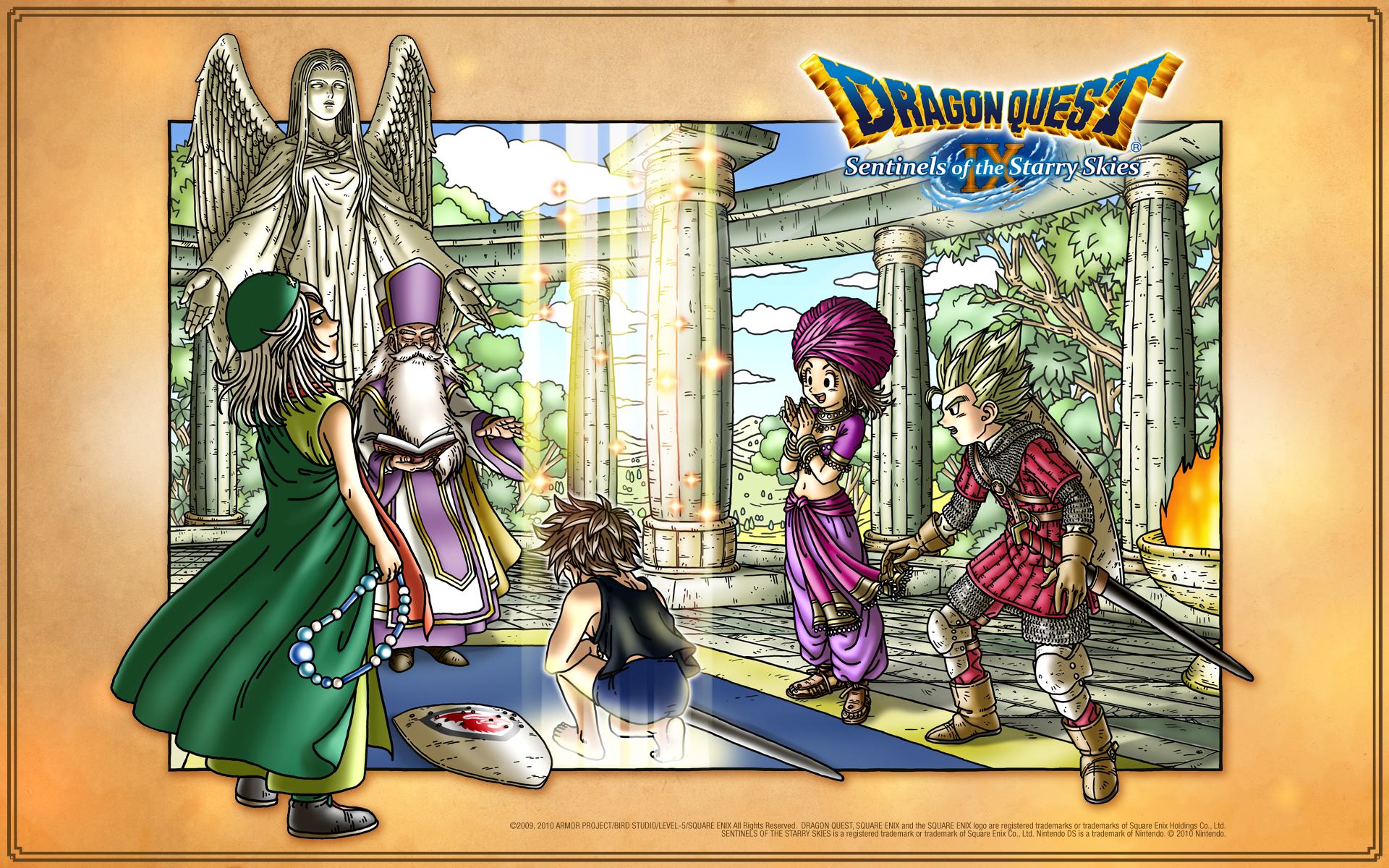
Dragon Quest IX – Official Art – Vocation Changing (DS)
Now in Dragon Quest IX, this system is used again with some slight changes, but the only relevant one for here is the Skill Point System. At certain levels, each character gains a number of “Skill Points” which may be spent on specialist abilities, kind of like a talent tree system.
See what I meant when I said there were loads of systems out there? Well, out of all of them, I’m tempted by a combination of the Esper System (FF6), the Materia System (FF7), the Job System (BD), and the Vocation System (DQ). Now this may sound overly complex, but hear me out; I want to use the Job and Vocation systems to influence the character’s stat growths, and use a combination of the Esper and Materia systems to teach them skills and spells. I would use some of the other two’s mechanics, but they would be far to difficult to replicate right now. Using the combination I’ve gone for makes it feel more organic to me, especially given my plot structure of having various “Vocational Guilds” attached to the Adventurers Guild. (See, I’m marrying my plot and gameplay). It also helps me work out abilities, as I can decide which ones could potentially be learned at what point in the narrative.
So there we have it! One of my core gameplay features sorted!
Bibliography:
Final Fantasy Wiki. (n.d.). Esper (Final Fantasy VI). [online] Available at: https://finalfantasy.fandom.com/wiki/Esper_(Final_Fantasy_VI) [Accessed 1 May 2019].
Final Fantasy Wiki. (n.d.). Materia (Final Fantasy VII). [online] Available at: https://finalfantasy.fandom.com/wiki/Materia_(Final_Fantasy_VII) [Accessed 1 May 2019].
Final Fantasy Wiki. (n.d.). Sphere Grid. [online] Available at: https://finalfantasy.fandom.com/wiki/Sphere_Grid [Accessed 1 May 2019].
Final Fantasy Wiki. (n.d.). Job System. [online] Available at: https://finalfantasy.fandom.com/wiki/Job_system [Accessed 1 May 2019].
Golden Sun Universe. (n.d.). Djinn. [online] Available at: https://goldensun.fandom.com/wiki/Djinn [Accessed 1 May 2019].
Golden Sun Universe. (n.d.). Character Class. [online] Available at: https://goldensun.fandom.com/wiki/Character_class [Accessed 1 May 2019].
Dragon-quest.org. (n.d.). Vocation System – Dragon Quest Wiki. [online] Available at: https://dragon-quest.org/wiki/Vocation_system [Accessed 1 May 2019].
Dragon-quest.org. (n.d.). Alltrades Abbey – Dragon Quest Wiki. [online] Available at: https://dragon-quest.org/wiki/Alltrades_Abbey [Accessed 1 May 2019].

 SLGameDesign FMP